Check the ports and capabilities first
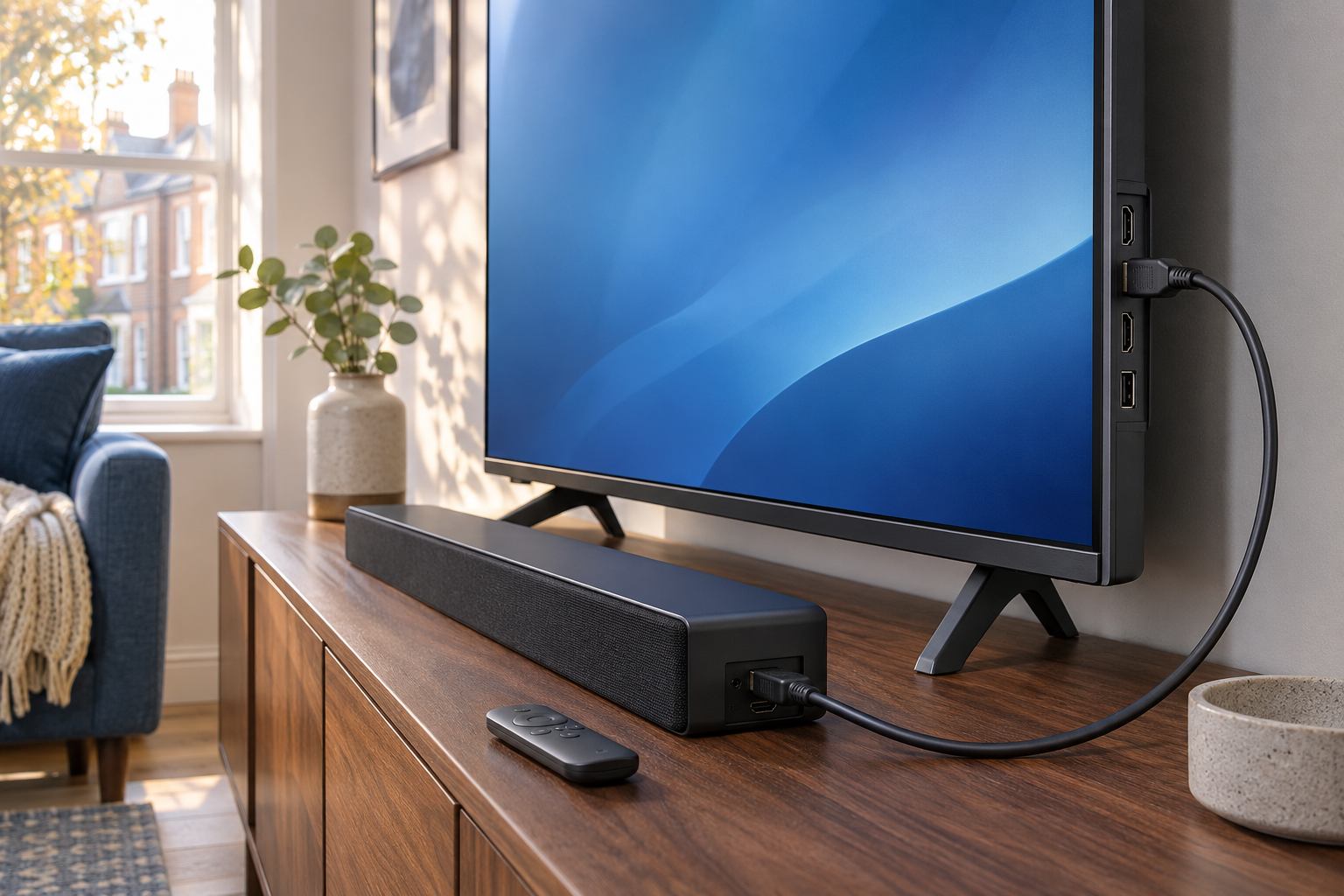
Look at the labels on the television and soundbar before choosing a cable route. On the Samsung TV, one HDMI socket may be marked ARC or eARC. On the soundbar, use the connection marked HDMI OUT (TV-ARC/eARC), HDMI TO TV or similar. A soundbar’s ordinary HDMI IN is for a source such as a console or player; it is not the same as the return connection to the television.
ARC stands for Audio Return Channel. It lets a compatible TV send audio back over the HDMI connection to an audio system. eARC is an enhanced version with support for higher-bandwidth audio formats when the TV, soundbar, source and settings all allow them. HDMI’s eARC explainer describes the single-cable return path. The marking on the port matters more than the age or price of either device.
Find the exact model numbers on the devices or in their menus, then check both manuals. Some Samsung televisions use a One Connect box, so the relevant socket may be on that box rather than on the screen. If either device lacks ARC/eARC, use a compatible alternative such as optical audio and follow the model manuals. Do not assume an unlabelled HDMI socket supports TV audio return.
Make the direct HDMI connection
Samsung UK’s soundbar setup guide recommends checking the connections with the devices switched off. Connect one end of a suitable HDMI cable to the TV’s ARC/eARC socket and the other to the soundbar’s TV ARC/eARC socket. Make sure both plugs are fully seated. Restore power and select the bar’s TV audio input, which may appear as TV ARC, HDMI ARC, D.IN or another model-specific label.
On the TV, open Sound settings and choose the connected external speaker or soundbar as the output. Samsung menus vary by generation. The UK external-speaker instructions show an eARC route and explain the output selection for supported sets. Use the on-screen labels you actually see rather than following a menu path from a different model year.
Start with a TV app you know plays sound. This tests the TV-to-bar return path without adding a console, set-top box or HDMI switch. Raise the TV and bar volume gently, check mute on both, then confirm that the bar is receiving sound. If it is silent, verify the two socket labels again before changing more settings. Our HDMI cable guide covers cable choices; the correct ports and settings come first.
Set Anynet+ and eARC deliberately
Samsung calls its HDMI-CEC device-control feature Anynet+. On many TVs it is in External Device Manager, sometimes under Connection or General. The matching control option may also need to be enabled on the soundbar. Samsung UK’s Dolby Atmos setup guidance explains how Anynet+ and the audio-return connection work together on the models it covers.
If both devices support eARC, look for HDMI e-ARC Mode in Sound > Expert Settings and choose the supported setting. Samsung UK’s audio-format guide describes Auto and Pass-Through choices and notes that available options depend on the attached equipment. Enabling an eARC menu item cannot give an ARC-only soundbar eARC hardware. If the bar supports ARC only, use the settings in its manual and establish basic sound before exploring advanced formats.
A TV remote may control the bar’s volume through HDMI-CEC, but control behaviour differs across brands. Test it after audio is working. If power or volume commands behave unexpectedly, check the CEC settings on both devices instead of swapping cables immediately. Turning a setting on and off without recording its original value makes troubleshooting harder; change one item at a time.
Match the audio format to the full chain
Stereo or standard surround sound is a sensible first test. Once you have reliable audio, try the format required by your source and soundbar. Dolby Atmos, lossless formats and pass-through depend on the content, app or player, TV, HDMI path and bar. A logo on one device does not guarantee that every programme or input will deliver that format.
There are two common paths for an external source. You can connect it to the TV and send audio back to the soundbar through ARC/eARC. Or you can connect it to a soundbar HDMI input and pass video onward to the TV. The second path works only if the bar passes through the video capabilities you need, including resolution, refresh rate and HDR format. For a games console, connecting directly to the TV may preserve features that a particular bar cannot pass through.
If one app or source is silent while another works, check that source’s audio output format. Try a basic supported setting temporarily to locate a format mismatch. Samsung’s UK audio-format explanation distinguishes Auto from Pass-Through, but the exact choice should follow your connected equipment’s manuals. Avoid asserting that one setting is best for every model.
Find the fault without changing everything
| What you notice | First checks |
|---|---|
| No sound from any TV app | ARC/eARC socket labels, bar input, TV sound output, mute |
| Sound from TV apps but not a console | Console audio setting, TV input format and source path |
| TV speakers play instead of bar | External-speaker selection and HDMI-CEC control |
| Intermittent audio after standby | Connection seating, CEC settings and device updates |
| Voices do not match lips | Audio-delay controls on TV, bar and source |
Test a TV app and an external input separately. If the TV app works, the return path is probably functioning and the external source path deserves attention. If neither works, remove any HDMI switch or adapter and connect the TV directly to the soundbar for diagnosis. Try another known-compatible cable if a plug is loose or the connection remains unreliable. Avoid bending the lead sharply behind a wall-mounted TV.
Restart both devices after a single setting change, then note the result. If the bar and TV have separate firmware, follow each maker’s own update procedure. Our Samsung TV update guide covers the television side. Never install a TV firmware file on a soundbar. If a persistent fault appears after an update, use the manufacturer support pages for the exact model rather than assuming an ARC/eARC setting has the same name everywhere.
Check everyday operation before hiding the cable
Once sound is stable, test how the setup behaves when you switch the TV off and back on. Start a TV app, change to a set-top box or console, change volume with your normal remote, and return to the app. Confirm that the intended sound output is retained. A one-time sound check does not reveal a standby or input-switching problem.
Now route the HDMI lead with a gentle bend at both sockets. Leave enough slack to move the TV or soundbar for cleaning, without a loop that catches a mount. Keep the TV and bar ventilation clear. Our guide to hiding TV wires covers labels, clips and accessible power. Photograph the working port connections before you secure the final ties.
If your bar is not a Samsung model, use its own instructions for input naming and HDMI control. Some models have no display; others switch to the TV input automatically. If HDMI ARC/eARC is unavailable, an optical connection can be a useful fallback, though its supported formats and control behaviour differ. Use the bar’s manual to select the correct input and the TV’s menu to select the corresponding output.
Samsung TV soundbar questions
Which HDMI socket on my Samsung TV should I use? Use the one explicitly labelled ARC or eARC, which may be on a One Connect box. Check the manual for your model if the marking is hard to reach. Do not assume HDMI 1 or HDMI 3 is universal.
Does an eARC TV work with an ARC soundbar? Often the devices can establish an ARC connection, but available formats and settings depend on both models. Follow their manuals and test basic TV audio before seeking eARC-only features.
Why does my soundbar show D.IN instead of TV ARC? Some bars use D.IN as a starting input or use a different display label. The display alone does not prove which HDMI port is connected. Verify the actual port markings and the bar’s model instructions.
Can I use the same remote for volume? HDMI-CEC/Anynet+ can enable volume control on compatible equipment. Check both devices’ control settings and test standby and input switching as well as volume. Cross-brand behaviour varies.
Why is a streaming app silent while the menu clicks work? The app may use a different audio format. Check its output settings, the TV digital audio format and the bar’s supported formats. Try a simpler supported format to isolate the mismatch, then restore the best compatible option.
Editorial copy updated 18 November 2026. Model listings were not rechecked for this update. Menus and compatibility can change. Use the instructions for your exact model where they differ.
Back to top ↑