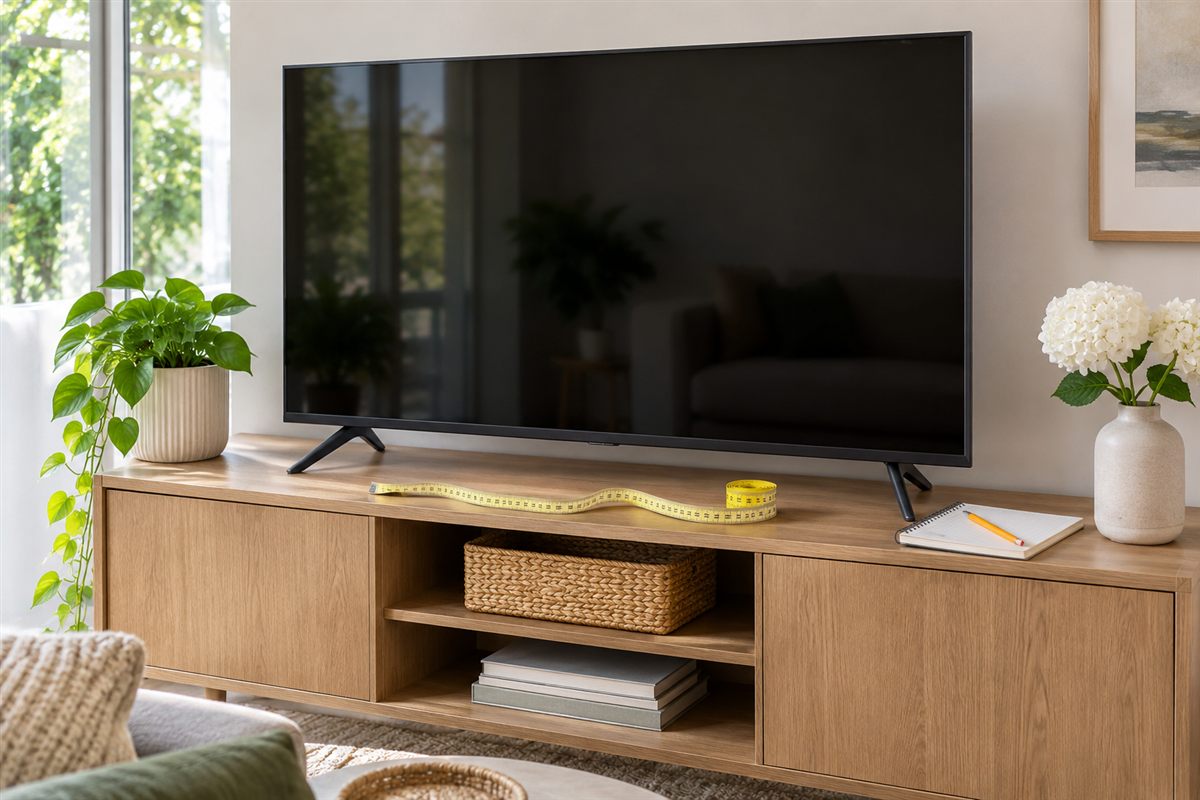
Measure the visible screen diagonal
Use a tape measure from one corner of the visible display to the opposite corner. Keep the tape clear of the delicate screen surface and exclude the bezel. If you measure in centimetres, divide by 2.54 to convert to inches.
For example, a diagonal of 139.7 cm is 55 inches. Real products may use a nominal size, so a small difference from the advertised figure is not automatically a fault. Samsung's size guide confirms that TV screen sizes refer to this diagonal measurement.
Do not measure horizontally and call the result the TV's inch size. Two measurements answer different questions: the diagonal identifies the screen category while width helps establish fit.
Use the model's official specification if the TV is already mounted high or difficult to reach. Do not press a metal tape against the panel or climb to measure it alone. Write down both the number and its unit. A marketing size class can be rounded, while the manufacturer's detailed sheet may give a more precise visible diagonal.
A diagonal tells you how large the picture is, but it does not predict furniture fit. A 55-inch screen is not 55 inches wide. Keep a separate line in your notes for the outer width, which includes the bezel and any parts that extend beyond the picture.
Record the dimensions that affect fit
| Measurement | Include | Why you need it |
|---|---|---|
| Cabinet width | The whole outer frame | Fit between furniture or wall features |
| Height without stand | Full TV body | Wall position and clearances |
| Height with stand | TV plus its feet or base | Shelf and cabinet fit |
| Depth with stand | Full supporting footprint | Furniture depth |
| Foot spacing | Distance across the supporting feet | Usable support width |
Use the manufacturer's dimensional drawing when shopping. Product listings sometimes mix measurements with and without the stand. Check the units and label before comparing two models. Leave the ventilation clearance specified in the manual rather than planning an exact, tight enclosure.
Check the exact configuration you intend to use. A set's published depth without stand is not the front-to-back footprint on a console. Some feet sit near the outer corners; others can move to a documented narrow position. Record the distance between the furthest support points and the depth of the feet, then compare both with the usable flat surface of the furniture.
Sony UK's A90K specifications separate with-stand dimensions, without-stand dimensions and the mounting-hole pitch. They show the kind of distinctions to look for, not measurements for a different model. Cable plugs and bend radius may need extra room behind the advertised depth.
Use screen estimates only for early planning
For a 16:9 screen, width is approximately 0.872 times the diagonal and height approximately 0.490 times the diagonal. These are geometric estimates for the picture area, not the outside dimensions of a finished television.
| Nominal diagonal | Approximate screen width | Approximate screen height |
|---|---|---|
| 43 inches | 95.2 cm | 53.5 cm |
| 55 inches | 121.8 cm | 68.5 cm |
| 65 inches | 143.9 cm | 80.9 cm |
Use those figures to sketch a possible picture area, then replace them with the exact model dimensions before ordering. A thicker bezel or widely spaced feet can change whether a television fits. Our 55-inch TV guide gives a shortlist to investigate once the space is measured.
The table is a sketching aid. Its widths assume an exact 16:9 rectangle, so they do not include a frame, side speakers or stand. If the chosen TV has a different aspect ratio or a curved panel, the estimate is less useful. For a cabinet, recess or alcove, use the manufacturer's actual overall width and height.
Convert measurements consistently: centimetres divided by 2.54 gives inches, and inches multiplied by 2.54 gives centimetres. Keep the original figure alongside the conversion. Rounding early can hide a few millimetres of clearance, which matters when a set is close to a shelf or wall feature.
Measure a wall installation separately
Record the TV's weight without the stand, VESA hole spacing and the mounting instructions for the exact model. VESA spacing measures the horizontal and vertical distances between the mounting holes, usually in millimetres. It is not derived from the screen diagonal.
The mounting holes may sit above or below the centre of the television. That offset matters when placing the wall plate. Our wall-mounted TV height guide explains the difference between screen-centre height and bracket height.
Keep cable bends, plug depth and access in mind. A slim screen does not mean the whole installation can sit flush against every wall.
VESA's mounting standard describes the flat-display mounting interface, but matching hole spacing is only one part of compatibility. Check the TV's weight without stand, the bracket's rated range, screw type and length, wall material and the maker's installation instructions. A 400 by 300 mm pattern, for example, describes hole spacing rather than a safe wall fixing.
Do not assume the bracket's centre aligns with the screen's centre. Obtain the mounting diagram before drilling and mark the bracket location from its actual offsets. If the wall construction or fixings are uncertain, use a qualified installer. Keep the TV manufacturer's ventilation and cable-access requirements in the plan.
Check the route into the room
Before ordering a large television, measure doorways, stairs and tight turns as well as the final space. Check the packaged dimensions and delivery terms. A television that fits the wall may still be awkward to get upstairs in its box.
Use masking tape on the wall or a paper template to mark the proposed outer dimensions without touching the screen. Sit in your usual position and check nearby doors, lamps and furniture. This physical check can reveal a placement problem that a screen-size calculation misses.
Measure the narrowest part of the delivery route, including door frames, stair turns and lifts. The packaged dimensions may be much larger than the television itself because the box protects the panel. Samsung UK's TV size guide also calls attention to the physical dimensions of the set, stand and packaging.
Use the proposed position as a final check. Mark the outside cabinet dimensions on the wall with low-tack tape or a paper outline, then sit where you normally watch. Check whether the set blocks a socket, light switch or door. Leave the clearances required by the exact manual; a perfect geometric fit can still be an unsuitable installation.
Keep the measurement record usable
Make a short list before comparing models: visible diagonal, cabinet width and height, depth with and without stand, outside foot spacing, weight, mounting-hole pattern and the clearances in the manual. Add the full model identifier and the source of each figure. That prevents a retailer's rounded description from being confused with a manufacturer's technical sheet.
Compare one number at a time with the space available. For a console, the flat usable width and depth must support the feet. For a wall, the mounting details and wall construction matter. For a recessed cabinet, all outer dimensions and ventilation gaps matter. The screen diagonal is only a starting point.
Our screen-size reference helps you picture the image area, while the TV size guide helps with room choice. Neither replaces the exact set's installation drawing.
Check the final model before ordering
Before placing an order, confirm that the size, regional suffix and stand arrangement in the listing match the model whose dimensions you saved. A series name can cover several screen sizes and different foot positions. The same television can also have dimensions quoted with and without its stand, so match the heading on every specification line.
If the retailer gives a different figure from the official sheet, ask for clarification. Verify the delivery box size, especially for upstairs rooms. Record the intended TV location, stand configuration and any mounting bracket you plan to use. This makes an installer conversation more precise and helps you spot a mismatch before the set arrives.
A final physical fit check should leave room for plugs, airflow and normal access. If the layout is tight, select a model with documented dimensions that comfortably fit rather than relying on a nominal screen size.
Common questions
Is the advertised size the outside diagonal?
No. The advertised inch size usually refers to the visible screen diagonal, measured from one corner of the picture area to the opposite corner. The cabinet, bezel and stand are outside that figure. For a purchase, check the manufacturer's overall width, height and depth for the exact model, both with and without its stand. Those dimensions decide whether it fits a recess or cabinet; the screen diagonal alone does not.
What should I measure for a wall mount?
Record the TV weight without its stand, VESA hole spacing, cabinet dimensions and the bracket's specified limits. The wall construction and fixing method also need assessment. Measure the intended screen-centre height from the seated viewing position, then use the bracket manual to calculate where the wall plate goes. Leave space for cables, ventilation and any arm movement. Do not mark holes from a generic size chart because VESA offsets differ between models.
Why does a size chart differ from the TV dimensions?
A chart normally estimates the width and height of a standard 16:9 picture, while actual TVs have bezels, housings, stands and sometimes unusual aspect ratios. Use a chart to compare screen sizes early, then switch to the exact model specification before ordering. Also check the delivery route, lift space and packaging dimensions where access is tight. A few centimetres of clearance can matter more than the nominal diagonal.
Should I measure before or after choosing a model?
Measure the room and furniture first to set a realistic size range. Once you have a shortlist, check each exact model's published dimensions and stand footprint. Measure again at the proposed installation position, including sockets and cable bends. If wall mounting, confirm the bracket and wall support separately. Keep the measurement record with the model code so a similar-looking replacement is not assumed to have identical dimensions.
Editorial copy updated 19 November 2026. Model listings were not rechecked for this update. Menus and compatibility can change. Use the instructions for your exact model where they differ.
Back to top ↑